The Final Girl Theory refers to the last girl that is alive in a typically slasher/horror film that confronts the killer. This theory has been used in many films such as: - Halloween - Friday the 13th - Scream - The Strangers - A Nightmare on Elm Street The term was founded by Carol J. Clover in 1992 in the book she wrote 'Men, Women and Chainsaws: Gender in the Modern Horror Film' and suggests that the audience take the perspective of the killer at the start of the film and then towards the end they begin to move towards the 'final girl'. The concept is usually that the characters are killed one by one with the last remaining character being the woman who either vanquishes the killer or manages to escape. According to Clover the 'final girl' shares many characteristics, a few of which is that she is 'sexually unavailable' and does not participate in the use of drugs and alcohol. This theory focuses on the gender representations of the characters in a typical slasher/thriller film and argues that when the girl faces the killer she becomes 'masculinized' by taking a weapon to confront the killer. Also because it is generally a male orientated genre of film, this makes it easier for the audience to identify with a female character. Clover states that in order for a film like this to be successful, it is necessary for the surviving character to be female otherwise the mostly male audience will reject it. We felt that because our main inspirations were Halloween, Scream and The Strangers, it would make sense to portray this theory in our trailer. This, along with Laura Mulvey's Male Gaze theory, we decided on our main characters being female. Also we suggested there was a 'Final Girl' at the end of our trailer where she is backing away from the clown into a corner holding a bat as a weapon.
This is our research into Laura Mulvey and her theory of the 'Male Gaze'. The Male Gaze says that women are typically the objects rather than the possessors in a film because most films were targeted at heterosexual males
MEN AS WATCHERS
WOMEN AS WATCHED
Some of the features of the Male Gaze are:
the camera lingers on a woman's curves
events which happen to women are presented in the male point of view
Narrative Theory is, in media terms, the organisation given to a series of facts. It is important because, without this coherence, the audience would become confused. Narrative theory helps the director control how the audience feels. There are seven different theories that we have looked at:
ARISTOTLE Narrative should be created within a 'unity' of time, place and action. This theory no longer applies to modern day media as progression in technology means that we can look back in time during a film or trailer.
FREYTAG'S DRAMATIC STRUCTURE Freytag's theory is divided into five different parts:
Exposition
Rising action
Climax
Falling action and denouement/catastrophe/resolution
Audiences tend to feel unsatisfied when a story does not have a conclusion (e.g. ending on a cliffhanger). The film clip is from Inception which ends on a cliffhanger ending as the audience does not know whether Cobb (Leonardo DiCaprio's character) is dreaming as the shot cuts to black before you see whether his totem stops spinning.
BARTHES' ENIGMA CODE
Barthes' theory says that all narratives share the same structural features that are brought together in different ways. Although individual narratives differ, they have a limited number of organisational structures that affect how we read texts. These are called 'Narrative/Enigma Codes'. He says that is always more than one way to interpret a text.
The Enigma Code is a theory that suggests that telelvision, film, posters etc make the audience question something and draws them in. For example, a murder mystery will not reveal the face of a murderer until the end of the movie or program. The movie, Scream, does this. As the killer is masked, however the audience finds out who it is at the end of the film.
SYD FIELD'S THREE ACT PLOT STRUCTURE
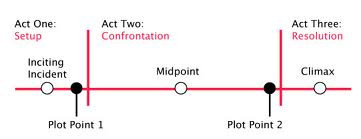
Syd Field, author of Screenplay and The Screen Writer's Workbook, has outlined a paradigm that most screenplays follow. A paradigm is a conceptual scheme. This paradigm is the structure that holds screenplays together. According to Field, screenplays follow a three-act structure, meaning the standard screenplay can be divided into three parts: Setup, Confrontation, and Resolution. Act I comprises the first quarter of the screenplay. (For a two hour movie, Act I would last approximately 30 minutes.) Act II comprises the next two quarters of the film. (For a two hour movie, Act II would last approximately 60 minutes.) Act III comprises the final quarter of the film. (For a two hour movie, Act III would be the final 30 minutes.)
The "Plot Point"--According to Field, the three acts are separated by two plot points. A plot point, often called a reversal, is an event that thrusts the plot in a new direction, leading into a new act of the screenplay. Later screenplay gurus have built on Field's theory by stating that Plot Point #1, which leads into Act II, is the moment when the hero takes on the problem.
LEVI-STRAUSS - BINARY OPPOSITION
Narrative tension is based on opposition or conflict. This can be as simple be as simple as two characters fighting, but more often it is an ideological level for example, in Western films the cowboys and indians both represent different sides. TODOROV'S THEORY Todorov's theory says that all narratives have a basic structure.
This theory is the simplest form of narrative. It is sometimes referred to as the 'Classic' or 'Hollywood' narrative.
VLADIMIR PROPP
Vladimir Propp proposed that characters take on the role of narrative 'spheres of action' or functions. Some of the characters that he said that are in all narratives are:
Slow pace of editing and gradually builds tension up
Clear binary opposition’s e.g. good v evil
Use of low key lighting
Dominant, hegemonic representation of gender: The Female Victim
Extensive use of close up
Incidental non-diegetic sound
Distorted diegetic sound
Extensive use of narrative off-screen space
Young/teenage characters
Use of hand-held camera: audience identification/realism
Point of view shots
Low angle shots
Secluded location: place characters where there
is no-one around to help them e.g. woods, abandoned house etc.
Characters forget about the threat of the film
Power cuts
Phone lines cut off
Someone investigates a strange noise
Victim falls over
Vehicle won’t start
'The fake scare'
Someone killed early on
Show a different time period '5 years later'
Storm
Quick cuts
The bullet points in red and bold we thought we might want to portray in our own film trailer as we felt that they suited our storyline and would be the most relevant to incorporate in order to give off a typical representation of a horror film.
We created a timeline showing how horror movies have changed since the 1930s. It looks at what the films were based around e.g. monster, supernatural, psychological and describes how the horror genre has developed. The timeline also has examples of horror movies that came out at the time and their movie posters.